Why Demand Is Rising While Careers Are Shortening
Community association management is living a paradox: there’s never been such a high demand for the work, but the people doing it are leaving faster than organizations can replace them.
But community manager turnover is not a motivation problem; it’s structural. And that makes this a paradox with an answer. The numbers don’t lie– we know why CAMs are leaving at record rates, and we know what drives HOA manager burnout.
What Makes This Shortage Unique
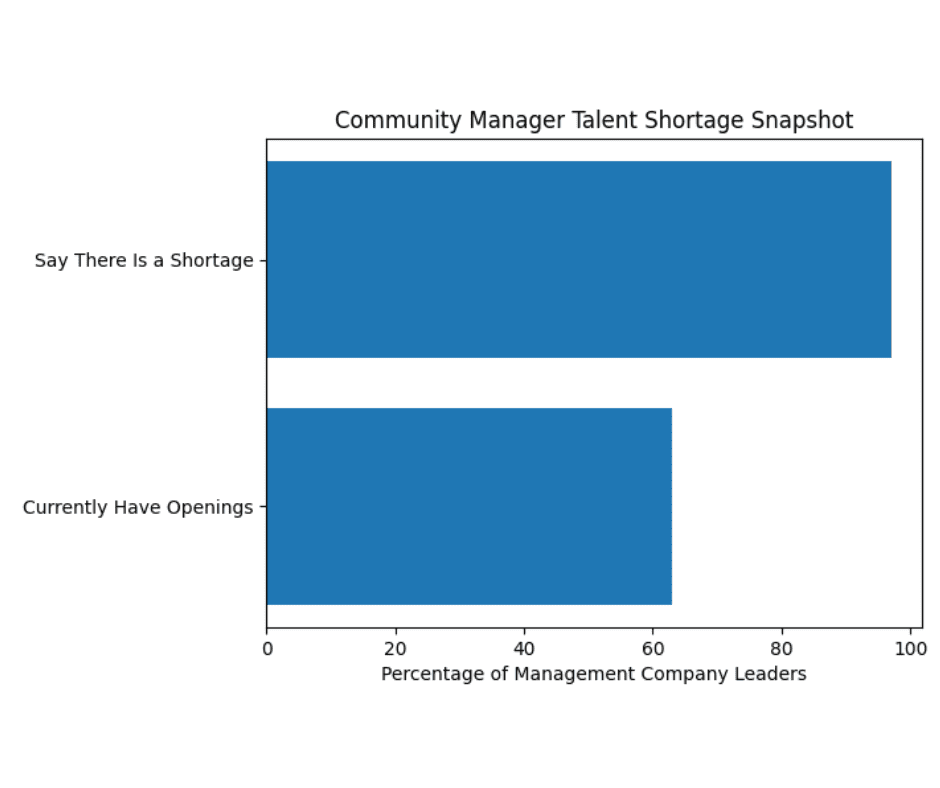
The talent shortage is no longer anecdotal. A CAI Foundation study of management-company CEOs and hiring staff, 97% said there is a shortage of community managers, and 63% said they currently have openings– substantially over half. That same report cites about five years of average tenure for CAMs as reported by organizational leadership, while their manager respondents reported an average tenure of seven years.
Looking at tenure rates doesn’t define churn, but it does illuminate what replacement pressure looks like. In a steady-state organization, an average tenure around five years roughly corresponds to replacing about 20% of the workforce each year, give or take. That is a big annual change, even before you account for community growth and expanding service expectations.
It is also worth zooming out to the broader property management conversation. HOA-only turnover data isn’t always clear, so the bigger picture can be extremely useful to look at the state of the industry. It’s a good proxy reference point for understanding what “high churn” looks like in the industry at large. Data from the National Apartment Association points to 33% turnover in apartment/property management– that’s a third of the workforce. The HOA management workforce shortage is part of that same churn dynamic, and the workload curve keeps rising as more communities come into being.
Growth Amplifies Workforce Pressure
At the same time, we know that the growth-driven demand is real, too. 78% of newly built homes in the U.S. are located in community associations, and as many 4,000 new community associations are created each year. The pipeline of work is expanding at the same time the pipeline of people is tightening.
This demand changes the “normal” baseline and day-to-day demands of the job. Even if your management company could magically freeze turnover tomorrow, the system would still be under strain because there are simply more communities entering the market and more residents demanding a concierge experience… which is a big part of the problem.
What Drives Dissatisfaction?
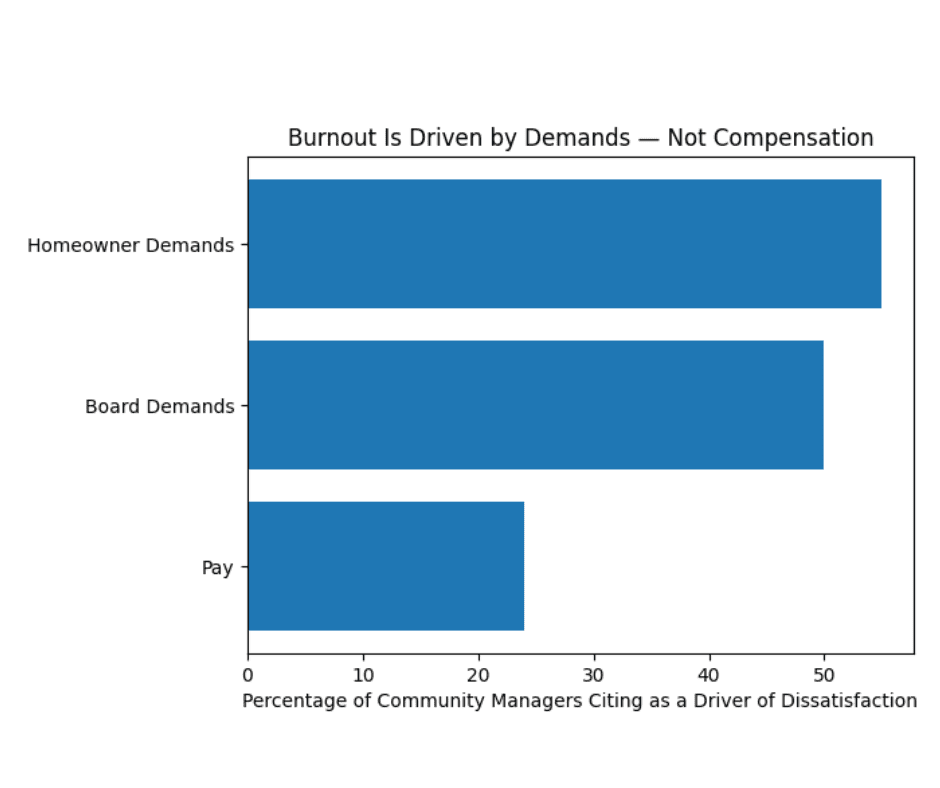
Unreasonable demands from homeowners is the number one answer. The CAI Foundation study found that the top driver of job dissatisfaction, cited by 55% of community managers, was homeowner demands. Not board demands (4th on the list, with 50% citing it as a driver) or pay (8th in line at 24%), but the day to day role that homeowners play. It suggests that what residents expect, what boards promise, and what managers can realistically deliver often do not line up; it’s a mismatch problem, not just volume.
And it’s not just resident demands that lead to CAM struggles. Board stressors and other community association management challenges play a role, too. In the same 2024 industry report, board members pointed to maintenance (42%), rule enforcement (38%), finances (30%), and finding or working with a community association manager (27%) among top sources of stress and key drivers for bringing in professional management. These are recurring responsibilities that can become emotionally charged and visible to residents… which makes them feel personal.
Put those pieces together and you get the core structural problem: the manager becomes the default pressure-release valve for the entire community, while still having to operate inside rigid boundaries.
Building a Structural Response
Now that we understand why managers leave, we can start to solve the problem. It’s a problem worth solving for the good of the whole community, because high HOA manager turnover shows up fast at the community level. When you ask how long do HOA managers stay in their roles, what you really want to know is how much institutional continuity your system supports. Every transition resets institutional knowledge, slows response times, and forces boards and residents to re-explain issues that a stable manager would already have mapped.
Any starting place must be helping residents understand what the CAM can and cannot do. Start with expectations, and write them down in plain language that makes sense to the community. Many unreasonable demands are not malicious; they’re just what happens when people fill in the gaps with assumptions.
Ultimately, if you want to reduce churn, you need to stop thinking about maintenance and start thinking about architecture. Your organization needs more than effort — it needs infrastructure. That’s where FRONTSTEPS comes in. As the system of record for community management, FRONTSTEPS provides the architecture that aligns boards, residents, and managers inside a single, structured operating environment.
Clear workflows, transparent communication, centralized data, and embedded financial tools reduce chaos, set expectations, and create guardrails that protect your CAMs from becoming the default pressure-release valve. When the operating system improves, retention follows. That structural shift is what allows community management companies to scale sustainably. Schedule a demo to find out how FRONTSTEPS can support community management.